How Reliable Is an Anion Gap Calculator?
What Does an Anion Gap Calculator Measures
A anion gap calculator determines the anion gap from standard electrolytes in a blood sample, usually using serum sodium, serum chloride, and serum bicarbonate. Some calculators also add serum potassium, while others leave it out because the effect on the final number is usually small. The goal is to help spot patterns in acid-base balance and support interpretation of laboratory results.
In essence, the calculation reflects the balance between measured positively charged and negatively charged particles in the blood. A change in the anion gap can indicate an excess of unmeasured acids or other shifts in physiology. That makes it valuable as a screening and assessment tool, but it is not a standalone answer. The value is best understood as part of a larger diagnostic picture that includes symptoms, the basic metabolic panel, and sometimes a broader electrolyte panel.
As the calculation depends on routine lab values, its usefulness is tied closely to the quality of the underlying measurements. If the sodium, chloride, or bicarbonate values are off, the calculated result will also be off. That is why the accuracy of the calculator is really a question about both the arithmetic and the reliability of the inputs.
How Reliable Is an Anion Gap Calculator?
The brief answer is that calculator reliability is usually good when the input lab values are reliable and the formula is applied correctly. The arithmetic itself is simple, so the main sources of inaccuracy are not the calculation step but measurement error, rounding, and differences in how results are displayed by laboratories. In other words, the calculator is only as accurate as the numbers entered into it.
For most routine use, the precision of an anion gap calculation is appropriate for clinical interpretation. However, small shifts in sodium, chloride, or bicarbonate can push the result across a reference range threshold. That means a value may appear typical, borderline, or abnormal depending on the lab method and the level of variability in the inputs. A borderline result should therefore be treated as an outlier that deserves added context rather than immediate conclusions.
Rounding differences can also make a difference. If one source reports bicarbonate as 23.4 and another rounds it to 23, the final calculation may differ slightly. The same is true for chloride and sodium values, especially when a calculator uses whole numbers while the lab reports decimals. These changes are usually minor, but they can affect the interpretation of a borderline result.
So, how accurate is it overall? A well-designed calculator has strong validity for estimating the anion gap, but not perfect consistency across every setting. It is reliable for screening and trend review, yet it should not be treated as more precise than the laboratory data that feed it.
Elements That Affect Accuracy
Several physiologic and technical factors can affect the final number. Some are related to the patient’s state, while others relate to how the lab measures the sample. Understanding these variables improves both calculation and interpretation.
Albumin
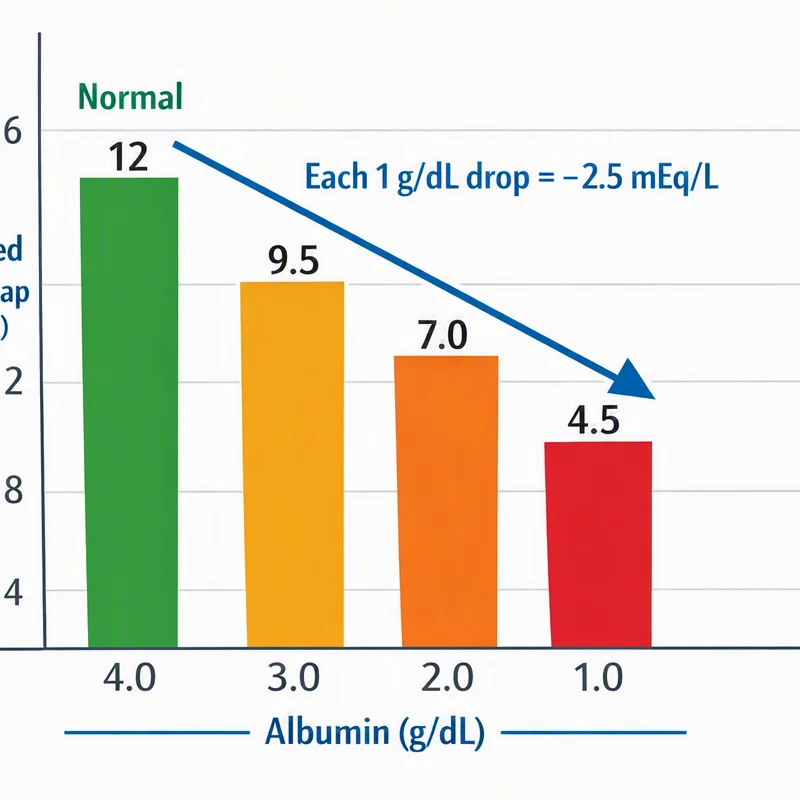
Albumin is one of the key factors because it is a major unmeasured anion in the blood. Decreased albumin can make the anion gap seem lower than expected even when an acid-base problem is present. That is why clinicians often use an albumin-corrected anion gap to improve the assessment. When albumin is abnormal, the uncorrected number may understate a true high anion gap process.
Bicarbonate
Serum bicarbonate directly affects the result because it is part of the calculation. If bicarbonate is lower, the gap may rise; if it is higher, the gap may fall. This makes bicarbonate a crucial value in evaluating possible metabolic acidosis. Even modest measurement differences can alter the apparent pattern, especially when the result sits close to the lab reference range.
Potassium
Serum potassium is included in some formulas and excluded in others. When potassium is included, the result may be marginally different, but the clinical meaning is often similar. The main issue is consistency: using one formula on one test and a different formula on another can make trend comparison harder. For reliable interpretation, the same calculation method should be used each time.
Assay method
The assay method used by the lab can create minor yet important differences. Different analyzers may read chloride or bicarbonate somewhat differently, which changes the final calculation. This is a form of analytical variability, not a fault in the calculator itself. If a result seems unexpected, it helps to consider whether the laboratory platform or reporting method has changed.
Practically speaking, the calculator is most reliable when the input data are recent, measured by a consistent lab process, and evaluated in the right physiologic setting. Problems arise when the inputs are incomplete, old, or altered by lab variability.
Typical Causes of Incorrect Results
Although a well-built calculator can deliver deceptive output if the source data are flawed. Most incorrect results come from before-analysis or data-entry issues rather than the formula itself.
Sample contamination
Sample contamination can distort electrolyte values and produce a false pattern. If a blood sample is contaminated with IV fluids or other substances, sodium, chloride, or bicarbonate may vary enough to skew the anion gap. This is a classic reason a result may not align with the patient’s condition.
Hemolysis
Hemolysis can disturb some laboratory measurements and may reduce the reliability of the reported electrolytes. Even though its impact varies by analyzer and specimen quality, hemolysis is still a reason to question an unexpected result. If the numbers do not fit the clinical picture, repeating the sample can be important.
Lab variation
Lab variation refers to differences in measurement between instruments, laboratories, or even repeat runs of the same specimen. This kind of variability can make a borderline anion gap look different from one test to another. When tracking trends, it is important to compare values from the same or similar methods when feasible.
Input errors
Input errors are among the most avoidable causes of incorrect calculations. A transposed sodium value, a missing decimal point, or an entered chloride value from the wrong report can lead to a completely misleading result. Since the calculator depends on exact numbers, even a small data-entry mistake can have a major effect on interpretation.
These issues highlight an important point: a calculator can only process the information it receives. If the blood sample is compromised or the numbers are entered incorrectly, the output may look precise while actually being inaccurate.
How to Understand the Outcome Correctly
Accurate reading needs more than measuring the number to a threshold. The anion gap should be viewed alongside symptoms, the full chemistry panel, and the cause the test was ordered. A result that appears normal anion gap or high anion gap has meaning only when placed in clinical context.
A normal anion gap often implies that there is no major accumulation of unmeasured acids, but it does not exclude all acid-base problems. As an example, some types of metabolic acidosis can occur with a normal gap. Likewise, a high anion gap may indicate excess acids, but the exact cause still needs workup rather than assumption.
The most accurate interpretation involves three questions:
- Are the electrolytes reliable and self-consistent?
- Does the result match the patient’s symptoms and other laboratory results?
- Is the value truly abnormal, or is it close to the cutoff because of ordinary fluctuation?
Clinical judgment matters because physiology is not always neat. A slight change around the threshold may reflect expected variation, rounding, or method differences rather than disease progression. A more pronounced deviation is more concerning, but even then it should be interpreted with the rest of the data.
In practice, the anion gap is a tool for pattern recognition. It helps identify whether further evaluation is needed, but it does not provide a final diagnosis by itself.
In cases where an Anion Gap Calculator Should Not Be Used Alone
An anion gap calculator must not be viewed as the sole basis for a diagnosis. It is an element of a larger assessment that may include symptoms, patient history, vitals, and extra testing. In many cases, a definitive conclusion requires blood gas analysis to assess acid-base status more directly.
The basic metabolic panel is often the origin of the needed electrolytes, but it does not resolve every concern. If the clinical concern is substantial, a physician may order an arterial or venous blood gas, repeat chemistry testing, or other studies to better define the pattern. The calculator can assist with screening, but it cannot replace professional review by a clinician.
This is most important when the numbers and the patient do not match. For example, an apparently abnormal gap may be caused by a reporting error, a lab artifact, or a transient variation rather than a true disorder. On the other hand, a normal gap does not eliminate an important problem if the broader picture indicates otherwise.
That is why physician evaluation remains vital. The calculator can guide triage and assessment, but it should not be used to make an independent conclusion about disease presence, severity, or cause.
How to Enhance Result Reliability
A number of practical steps can increase reliability and lower the chance of confusing results. These steps do not erase all limitations, but they do increase confidence in the final interpretation.
Repeat testing
Repeat testing is often the simplest way to confirm an unexpected result. If the anion gap is borderline or at odds with the patient’s condition, running again the blood sample can help determine whether the result was due to random variation, contamination, or a true physiologic change. A second measurement is especially useful when the first result is an obvious exception.
Corrected anion gap
A corrected anion gap adjusts for factors that distort the unadjusted value, especially low albumin. This enhances assessment when albumin is outside the usual range. Without correction, a patient with low albumin may look to have a less significant abnormality than actually exists. The corrected approach supports interpretation and supports better clinical decision-making.
Albumin correction
Albumin correction is a useful way to estimate the albumin-corrected anion gap. Because albumin strongly shapes the gap, adjusting for it can reveal hidden abnormalities. This is especially helpful when evaluating possible high anion gap states in patients whose albumin is reduced. Correction does not replace clinical judgment, but it can make the calculation more meaningful.
Validated lab data
Using validated lab data is critical. That means confirming the values came from a trusted laboratory source, were collected properly, and were reported in a consistent format. Good data improves calculation, interpretation, and consistency over time. If the inputs are trustworthy, the calculator’s output is much more likely to be accurate.
Overall, the best strategy is to treat the calculator as a support tool. Pair repeat testing, correction when appropriate, and attention to laboratory quality to improve reliability.
Frequently Asked Questions
How accurate is an Anion Gap Calculator compared with lab results?
An Anion Gap Calculator is usually highly accurate when it uses correct laboratory inputs from a reliable basic metabolic panel or electrolyte panel. The key limitations come from the source data, not the calculation itself. If the serum sodium, serum chloride, or serum bicarbonate values are affected by measurement error, the calculated result can differ from what is clinically expected. So the calculator is generally trustworthy, but it mirrors the quality of the lab values it receives.
Why might an anion gap calculator show the wrong value?
Wrong results can happen https://anion-gap-help801.evergrovio.com/posts/can-the-presence-of-paraproteins-lower-the-anion-gap because of sample contamination, hemolysis, lab variation, input errors, and rounding differences. The assay method used by the laboratory can also alter the numbers slightly. In addition, abnormal albumin levels may make the uncorrected value misleading. Any of these issues can change the apparent anion gap and lower reliability.
Does albumin affect the accuracy of the anion gap calculation?
Yes. Albumin has a strong effect on the interpreted result because it is a key unmeasured anion. Low albumin can make the gap look reduced than it truly is, which may hide a high anion gap pattern. Using an albumin-corrected anion gap improves accuracy and is often more useful for clinical context and interpretation.
Does an anion gap calculator alone diagnose metabolic acidosis?
No. An anion gap result may suggest metabolic acidosis, but it cannot make the diagnosis alone. It should be interpreted with symptoms, the full chemistry profile, and sometimes blood gas analysis. A normal anion gap does not exclude acid-base problems, and a high anion gap still needs explanation.
When should an anion gap result be confirmed with repeat testing?
Repeat testing is a helpful measure when the result is unexpected, marginal, not aligned with the patient’s condition, or possibly being affected by sample contamination or other pre-analytic issues. Verification is especially useful if the number is near the lab reference range threshold or if there are concerns about the measurement error in the original blood sample. If the repeat value shifts noticeably, that implies the first result may not have been reliable.
When used properly, an anion gap tool can be a useful tool for understanding electrolyte patterns. Used without context, it can be confusing. The most accurate interpretation always combines the calculator’s output with verified laboratory data, recalculation when needed, and thoughtful clinical assessment.